
Why Workplace EV Charging is the Ultimate RTO Strategy
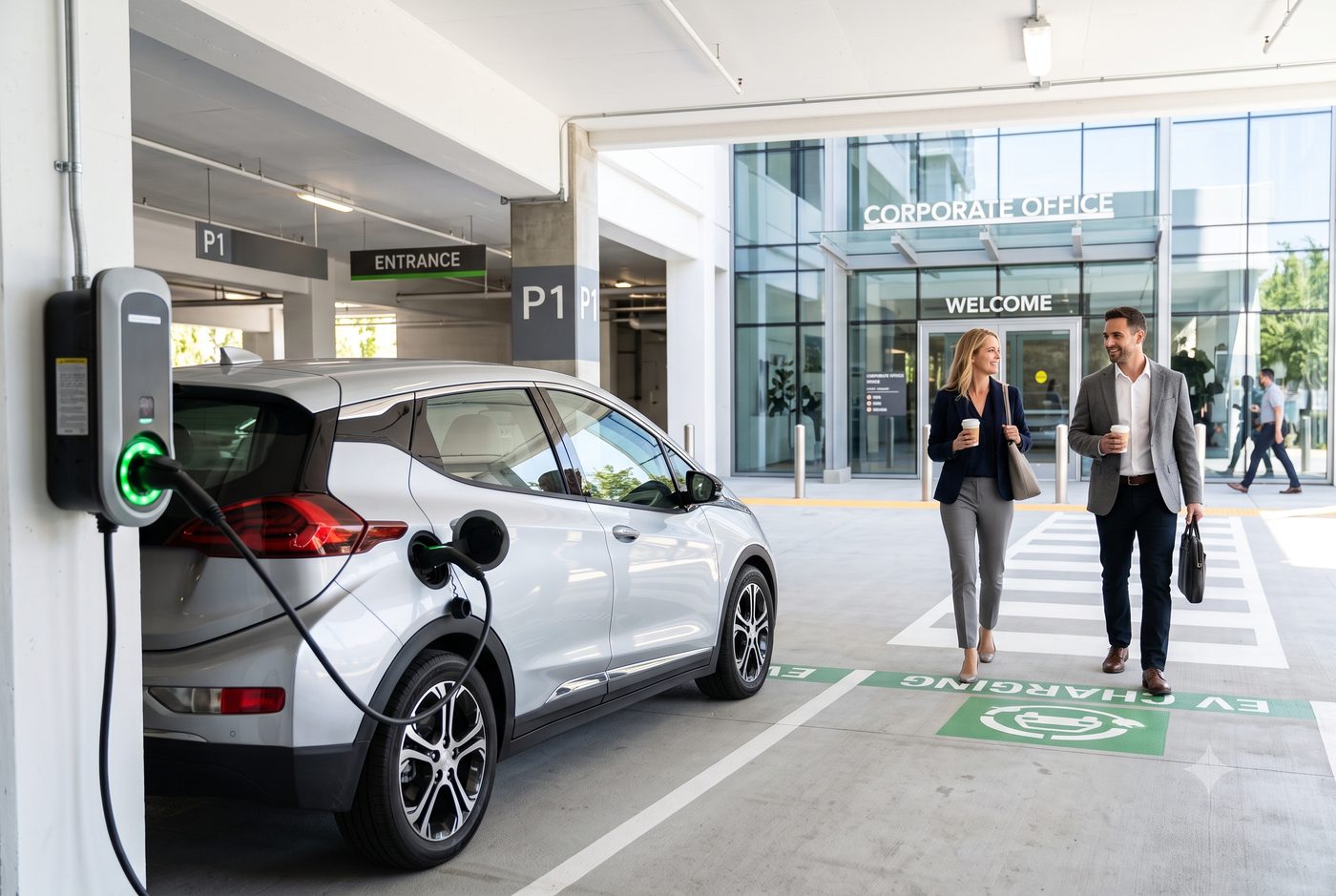
Why Workplace EV Charging is the Ultimate RTO Strategy
If you want your team back in the office, stop buying them free donuts and start buying them clean miles.
As companies continue to navigate the complexities of Return to Office (RTO) mandates, workplace EV charging has emerged as the ultimate HR tool of the decade. Recent mid-2026 data shows that companies offering subsidized or free workplace charging report a 15% higher compliance rate with hybrid-office mandates compared to those that do not.
But how do you deploy this benefit without breaking your corporate budget or causing chaos in the parking garage? Here is a breakdown of the dynamic Employee Value Proposition, the complex operational best practices, and the effective strategies for managing your building's load profile.
The Salary Multiplier: The True Value of Free Power
Workplace charging is more than just a convenience; free electricity at work is a direct financial subsidy for an employee's commute. This highly valued perk often costs the employer far less than a standard salary bump, making it an excellent investment for retention and attraction.
Consider the actual commuting impact: an average EV commuting 40 miles round-trip, 3 days a week, uses roughly 1,783 kWh of energy annually. While public charging rates for this mileage might exceed $750 per year, an employer offering free charging provides that exact utility offset.
The real benefit lies in the classification. Because this benefit is currently classified as a tax-free working condition fringe benefit by the IRS, that $750 utility offset is the equivalent of giving an employee a $1,100 pre-tax raise (assuming a 32% combined federal and state tax bracket). It's a highly visible, powerful financial incentive.
Defeating the "Spot Hog": Operational Best Practices
The biggest office headache isn't a lack of power—it is employees parking in charging spots for 8 hours when their car only needed 2 hours of energy. To prevent parking lot conflicts, implement these two key operational rules:
The Escalating Idle Fee: Make the first few hours (for example, the first 3 hours) of the charging session cheap or free to cover the actual energy transfer. Once the vehicle’s battery hits 100% and a brief grace period expires, introduce a steep idle fee (for example,$5.00 per hour). Nothing motivates an employee to move their car quite like a real-time phone notification charging them by the minute.
The Valet Rotation Model: For tight urban corporate garages, consider a key-handling system or designated valet service. Valets can cycle cars through a limited number of charging stalls and move fully charged vehicles into standard spaces, maximizing the hardware's daily utilization without requiring additional infrastructure.
The 9:00 AM Grid Spike: Load-Shifting the Commuter Fleet
When 200 employees arrive at the office between 8:30 AM and 9:00 AM and plug in simultaneously, it creates an enormous peak demand spike on the building's electrical service. Because commercial demand charges are billed based on the single highest 15-minute window of the month, this morning spike can add thousands of dollars to your corporate utility bill.
The solution lies in smart software configurations:
Priority Queuing: Use software to stagger charging cycles. Cars that arrived with a low state of charge (for example,10%) get prioritized, while cars sitting comfortably close to full (for example,80%) wait in a virtual queue.
Dynamic Throttling: Throttle charging speeds during the building's peak operational hours (typically 11:00 AM to 2:00 PM when the HVAC system is working hardest) and ramp up delivery during natural office energy troughs.
Take Action on Your Parking Policy
Workplace charging is no longer an optional luxury—it's a core HR asset. Review your corporate parking policy this week. If you have chargers installed but lack idle fees or load management, you are likely frustrating employees who can never find an open plug while unnecessarily inflating your utility bill. Implement a "Time-at-Plug" limit before your next corporate RTO push.
Tune in next week as we tackle the digital shield: Cybersecurity and protecting your building's network from charger hacks.