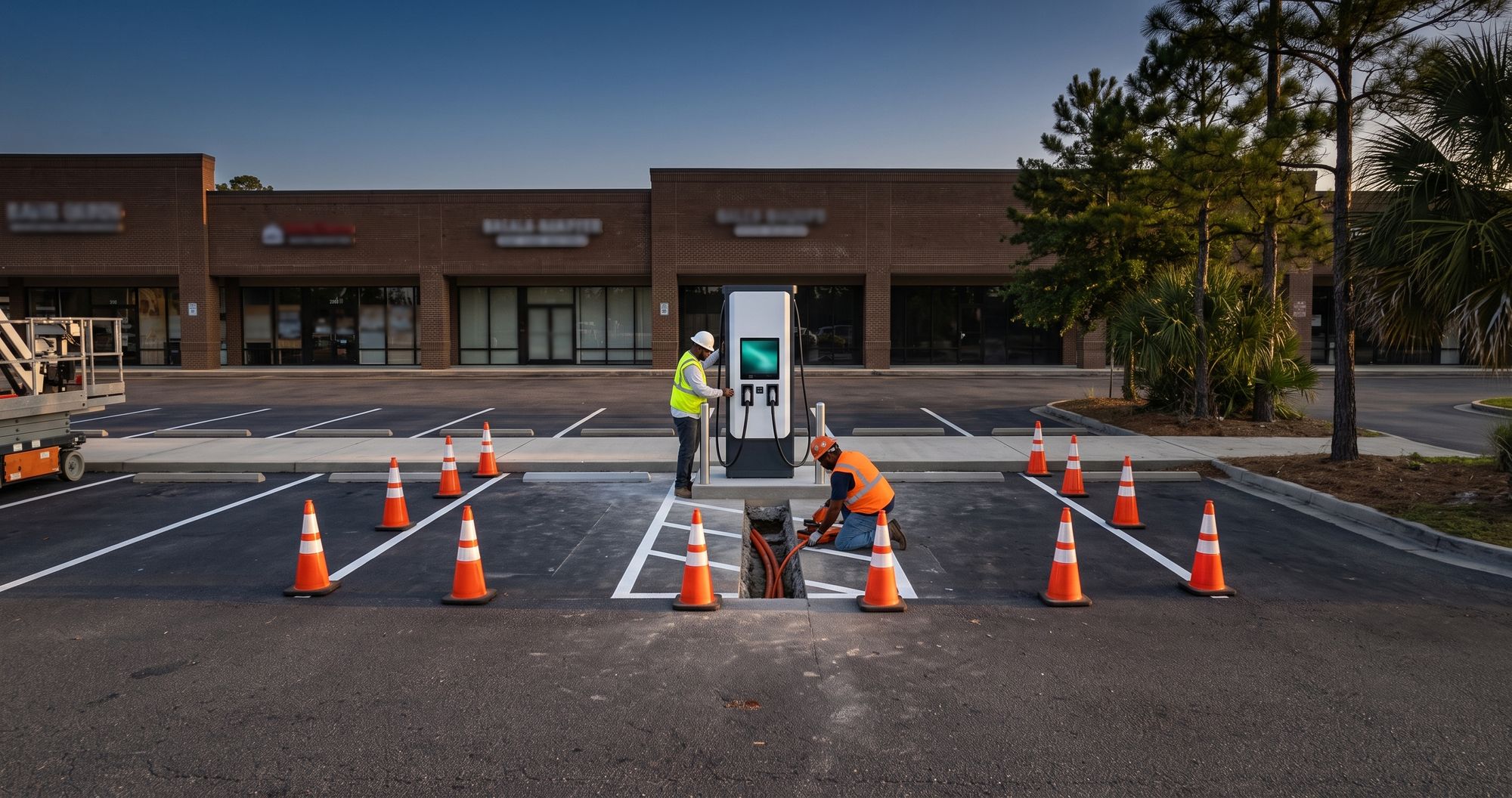
A charging build is a general-contracting problem, and you assemble none of it. Here is the whole sequence, and the build itself opened up — what open book actually means, a real two-stall configuration line by line, and the schedule the management fee is worked out on.
On paper a charging build is a general-contracting project — utility paperwork, equipment specs, an engineer, an electrician, an equipment vendor and a network operator. Let our team turnkey your project, or manage the build yourself once the charging solution is identified. The first two steps are free; costs enter only when you decide to move, and you see them.
Worth knowing which of these you could scope yourself: steps 3 and 4 are licensed work — a stamped drawing needs a licensed engineer and the utility interconnection needs a contractor, no matter who you hire. Steps 1, 2 and 6 are not. Any owner can pull their utility's DCFC rate schedule, ask the utility for a service-capacity letter on the address, and claim the site on the map apps drivers use. Do those three and you'll read every quote you get — ours included — far better.
1
Evaluate freeYour address scored against real stations: revenue range, competition, site score, in about a minute.
2
Plan freeA working call. Your actual utility rates and incentives into a first-pass proforma. If it's marginal, we say so.
3
Engineer scoped up frontUtility one-line, service confirmation, stamped permit drawings. We manage the engineers; you own the drawings.
4
Build open bookEquipment, make-ready, installation, energization — priced off the actual subcontractor contracts, which you see. An estimate before you commit.
5
Operate ongoingConnect 10 runs the station: access, pricing, payments, uptime monitoring and 24/7 driver support, plus maintenance. The station runs; you own it.
6
Promote ongoingRecharge Labs: driver targeting, campaigns, listings and loyalty — the utilization that makes the asset perform. Standard or built to suit the property, and priced per kWh.
Step 4, defined
What “open book” actually means.
It means you see the actual subcontractor contracts. Not a summary of them, not a line on our proposal that says what they came to — the documents themselves, for the electrical, the civil work, the equipment. The build price is built up from those, so every number in it has a contract standing behind it that you can read.
That is the whole test, and it is a document test rather than a wording test. A lump sum tells you what the job costs and nothing about how it got there; an open book hands you the inputs and lets you check the arithmetic yourself. It is also why the range on the Solutions page is a range — the contracts on a lot with a short run and spare service capacity genuinely read differently from the ones on a lot that needs a transformer and 300 feet of trench.
Which gives you the question to put to anyone who uses the phrase, us included: which documents do I actually get to see, and when do I see them? Ask it before you sign anything, with us or with the contractor down the road. An open book you are only told about after the work is done is a report, not an open book.
One build, every number in one place
OK, but what does it really cost?
It is the question everybody asks, so here is one real configuration end to end:
a single 200 kW charger serving two stalls at a retail site, running on
Connect 10 — the build behind the ~$125,000 to ~$190,000 range quoted on
the Solutions page.
Two numbers, not one, because the equipment barely moves and the construction does.
The charger barely moves next to what the ground does. What separates the bottom of
that range from the top is mostly the hundred feet of dirt between your electrical
service and the parking stall — and that is a fact about your property, knowable before anyone
quotes you.
What it is
What it costs
When you pay it
Needed?
EquipmentOne 200 kW charger, two stalls
~$67,000 to ~$80,000Moves with output, cable count and whatever the manufacturers are running — but far less than the construction does
Once, up front
Required
Construction & installationMake-ready, trenching, conduit, transformer, energization — run open book, what that means →
~$58,000 to ~$110,700The part your property decides. Managing the program is inside this number, not added to it
Once, up front
Required
The build, togetherWhat the two lines above come to
~$125,000 to ~$190,000Before incentives — utility make-ready and state rebates come off this
Once, up front
Required
PlatformAccess, pricing, payments, monitoring, 24/7 driver support — what the platforms do →
Connect 10: from 5.775¢ per kWh soldData and card processing are inside that numberOr Tap-N-Charge for card-only: a $0.75 session fee and 6.9% deducted, nothing recurring — the same structure on a DC site as on Level 2
Ongoing — only on power actually sold
Required
VoltCareAdvance exchange, so a failed unit is replaced rather than queued for repair
Read down the “when” column and the answer is: one large
number at the start, and two small ones per kilowatt-hour afterwards — both of which
are zero on a stall nobody used. Add the two together and, with the optional marketing
layer switched on, under 8.5¢ of every kilowatt-hour you sell goes to running and
promoting the station: 5.775¢ for the platform, about 2.5¢ for the marketing,
card processing already inside the first one. There is no monthly subscription on a
fast-charging build and nothing here is billed per port. VoltCare and Recharge Labs are
genuinely optional — the station runs without either.
Two things this deliberately doesn't do. It doesn't tell you what the site
earns — that depends on your traffic and your tariff, which is what the free
evaluation is for. And it doesn't tell you where in the range your lot lands:
that is what the table below is for, and it is worth putting to every bid you take,
ours included. Ask any builder which of these four conditions they assumed, because a
number quoted on the best case is not a number you can budget against. On Level 2 the
shape is different again — Connect 10 is a flat $199/yr per site plus $199/yr per
charger, a Tap-N-Charge unit has nothing recurring at all, and if you are not charging
for the electricity there is no platform fee either
(the platforms, side by side →).
Where your lot lands
Four conditions decide whether the construction runs nearer $58,000 or nearer $110,700.
None of them is about the charger. All four are facts about your property that you can
check before you talk to anybody — and any one of them going the wrong way moves
the number more than picking a different brand of equipment ever will.
What decides it
Pushes toward ~$58,000
Pushes toward ~$110,700
Service capacitySpare amperage already at the property
Enough headroom in the existing service to carry the charger
A service upgrade, and the utility work and lead time that comes with it
TransformerWho supplies it and where it sits
Utility-side transformer already adequate — nothing new on your pad
A new pad-mount transformer, its pad, and its protection
Run lengthDistance from the panel to the stall
A short run — the stalls sit near the electrical room
A long run across the lot, in bigger conductor, priced by the foot
Civil workWhat the conduit has to cross
Little or none — an open route, minimal restoration
Trenching, saw-cutting and repaving asphalt or concrete, islands, bollards, striping
Read it as a checklist on your own property, in that order. Walk from
your electrical room to the stalls you would use and count the feet, note what the route
crosses, and ask your utility two questions in writing: how much spare capacity the service
has, and whether the transformer serving you can carry another 200 kW. Those answers
place you on this table before a single quote arrives — and they are the same four
conditions on a Level 2 build, at a smaller scale, since the conduit does not care what
is on the end of it.
Equipment at ~$67,000 is the two-stall 200 kW configuration priced above;
commissioning, construction and installation are the balance. Ranges are before incentives
— utility make-ready programs and state rebates come off the total, and the free
evaluation prices yours.
Now one of them, opened all the way up.
The two-stall 200 kW build at the higher end of the range on the
Solutions page — the one with trenching and a transformer in it. Three lines, and they
add to the total. Our fee is one of them, not something added after it.
What it is
What it costs
EquipmentThe charger itself, delivered
$67,000
CommissioningConfigured, tested and brought into service
$2,700
Make-ready, site work and installationService, trenching, transformer, conduit, pad, the electrical run
and setting the unit — the subcontractor contracts you get to read
$98,771
Construction managementUs running it: scope, bids, schedule, inspections, energization
$11,888
The build, togetherBefore incentives — utility make-ready and state rebates come off this
$180,359
That management line is 12.0% of the work it manages, and 6.6% of the build.
It is charged on construction and installation only — never on the equipment, which
we do not mark up a second time for managing.
How that line is worked out
A rate that comes down as the job gets bigger.
A flat $1,699, plus a percentage of the construction and installation cost that
steps down in bands — the way tax brackets do, not the way a price list does:
On the construction and install cost
Rate
The first $20,000
14%
$20,000 to $50,000
10%
$50,000 to $100,000
9%
Above $100,000
7%
Each band only applies to the money inside it. The first $20,000 is charged at 14%
on a $30,000 job and on a $300,000 one; only the money above each line moves to the next
rate. That is deliberate, and it is what stops the edges being strange — there is no
point where one more dollar of scope suddenly cuts the fee on the whole job, and no reason
for anyone to shave a bid to land under a threshold.
Worked on the build above: 14% of the first $20,000, 10% of the next $30,000, 9% of the
next $50,000, and 7% of what is left, plus the $1,699 — $11,888 on $98,771 of
work. The same schedule applies to a Level 2 build, where the numbers are smaller and
the flat fee is a larger share of a small job.
Get started
Let's open the book on your lot.
Score the address free, or book a working call — we'll walk the site conditions that decide your number and put a first-pass build beside your real utility rates. No cost, no obligation.