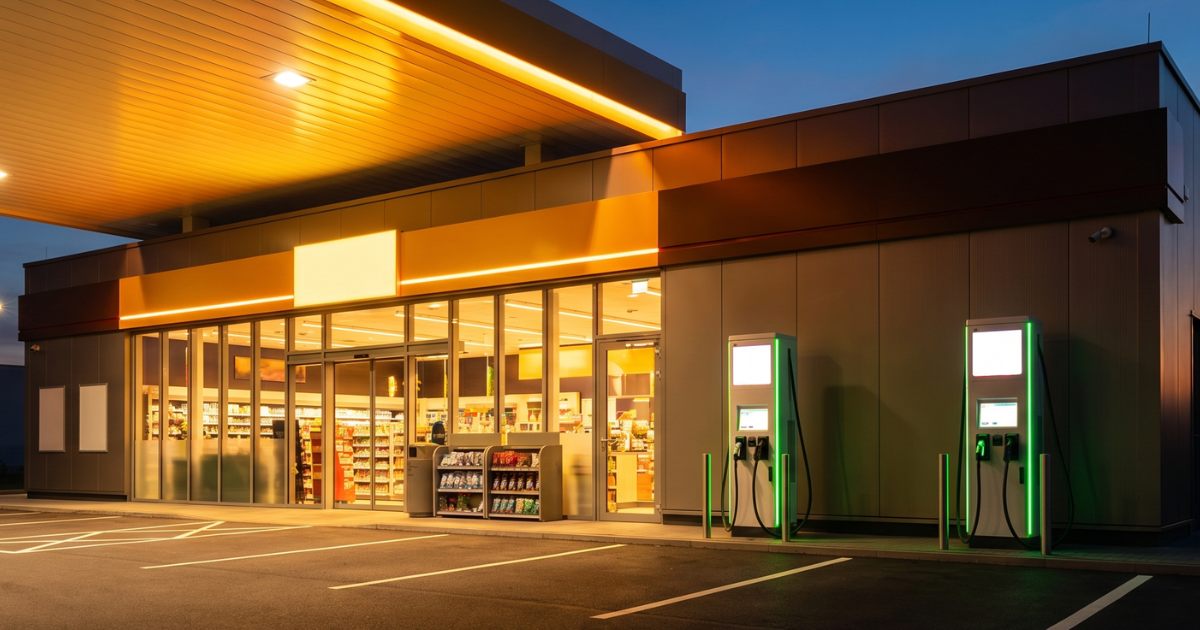
A Supercharger is the most recognized charging brand on the road, and for some properties it's exactly the right call. For others, a NACS-equipped unit from another manufacturer serves the same Tesla drivers and earns more. We build both, so we have no reason to steer you.

First, the half that isn't in dispute: either lane brings the same visit. A driver parks on your property for about half an hour and the rest of the property keeps what that half hour is worth — a basket, a room, a return trip — whether the post says Tesla or says your name. The second stream is lane-independent. What's left to decide below is brand and stall economics, and these are the three questions that decide it.
On a corridor exit competing with the next exit, yes — drivers route to the Supercharger they already trust. On a grocery-anchored strip serving the neighborhood, the cars are already there; the badge changes little.
Where dwell is long and traffic is moderate, demand charges decide the return, and a right-sized 60–200 kW unit beats a premium build. Where traffic is heavy, throughput carries the cost of either lane.
Some owners want the Supercharger sign because their customers do. Others are building a branded amenity — the way the biggest retailers moved from hosting to owning. Both are legitimate; only one is yours to brand.
Equipment bands before make-ready and incentives; realized charging speed is set by the vehicle, not the charger. Full specs and the rest of the lineup on the equipment page.
The hardware question is the smaller one — either way you buy the equipment and you own it, and either way we help you operate it. Installation is your call: bring your own contractor, or we turnkey the whole project. The real difference is the software. Both lanes answer the same four questions — who plugs in, what they pay, whether it's working, and where the money lands. The difference is who answers them.
Tesla's app, Tesla's driver support and Tesla's badge — though the badge is optional, since you can wrap or rebrand the unit. You set the price, and Tesla keeps a share of every kilowatt-hour, which Tesla sets. You own the equipment; the software layer is theirs, not ours — you control pricing, Tesla controls cost.
Ask Tesla for their current terms and put them in your model before you commit — it's a real line, not a rounding error, and it's the same question you should ask us. For a lot of owners the trade is worth it: it's the most hands-off charging there is.
One rate today, another next quarter, a guest rate and a public rate if you want both. Access is yours to open or gate, and we're the ones on the phone when a driver needs help.
The four questions, and what each platform charges to answer them →
And on either lane, the badge only decides who already knows the site is there. Everything else is promotion, which is a separate job from running the charger — that's Recharge Labs, and it works the same on a Tesla build as on ours.
You own the asset in both lanes. The question is whose software runs on top of it, and what that software charges — and we'll build you either one.
The Tesla decision is a hardware decision, and hardware comes after the site clears. Site Logic scores your address against a continuously monitored network of real stations — traffic, the home-charging gap, and what's already built nearby — in about a minute, free.
What happens next is yours to pick. Score it, learn how the call gets made, and make it yourself — the three questions above are the whole method, and they work on any quote from anyone. Or write us a check and we'll size it, build it, and run it. We're fine either way; we're not fine with you buying a lane you can't explain.
Run the free evaluation →Bring the address. We'll bring the data, your utility's rates, and a straight answer on the Tesla question.