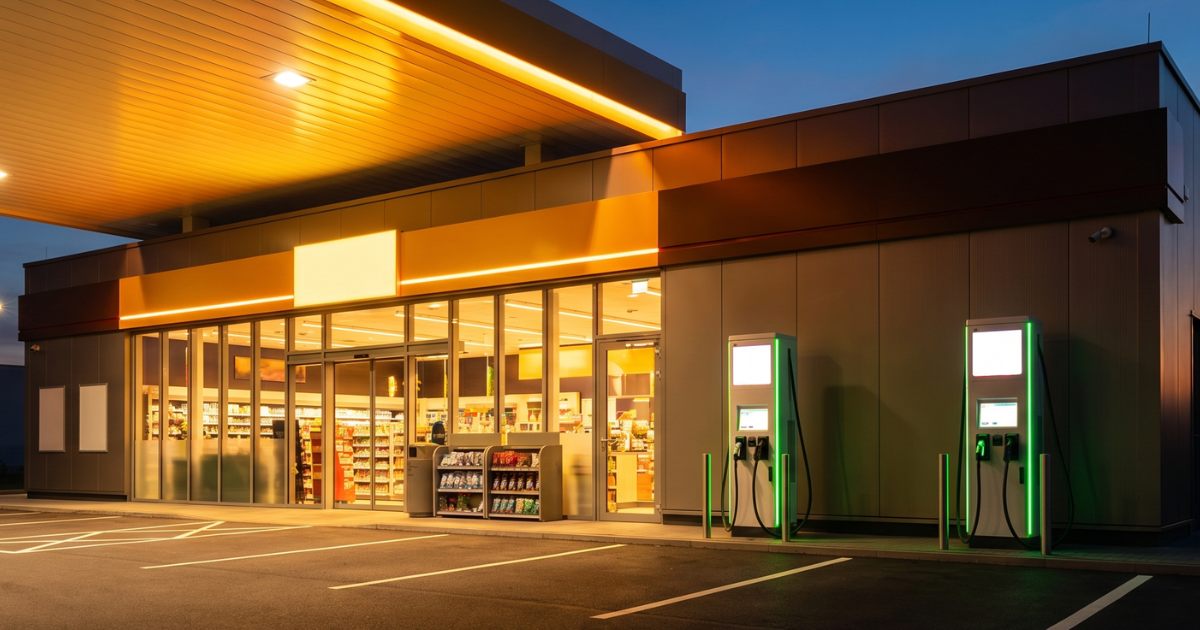
Where cars come and go all day, a fast charger earns on every session — retail margin on the power, plus half an hour of a customer parked steps from your door. We evaluate the site on real station data, build it open-book, and run it. You own the asset. You keep the revenue.
Charging income is net operating income, and NOI is value — it capitalizes at appraisal like any other line. Here's the range by property type on sites that score well. Every property scores differently; the free evaluation returns your address's actual figures.


Illustrative for sites that score well. Payback is figured on the build each tile assumes — two stalls for hospitality at ~$125,000 to ~$190,000, four stalls for retail and c-store at ~$185,000 to ~$295,000, both before incentives — the low end assumes service capacity already at the pad and no civil work, the high end is the more typical build with trenching and a transformer. Asset value is charging NOI capitalized at a 7% cap rate, so it turns on what the site earns and not on what the build cost. Your site's own numbers come from the free evaluation and your actual utility tariff. See what that build costs once, and what runs after it →
The charger brings the visit; the rest of the property keeps what the visit is worth — so one session earns twice over. The tiles above are only the first of those. And both of them land a third time on the balance sheet, because charging income appraises like any other NOI.
A fast-charging session parks a customer at your property for about 35 minutes — observed across a continuously monitored network of real stations. That's captive dwell time steps from your tenants' doors, and nearby renters who can't charge at home come back to charge where they can.
Those 35 minutes are the second stream. A basket at the register. A room booked because the charger was on the listing. A tenant who renews because charging is at their door. None of it runs through the charger's meter, and all of it lands on the same P&L — which is why the mechanism compounds rather than just adds: the charger is a reason to come, and the business you already run is what's standing there when they do.
You can size that half yourself, on any property, without us. Take the sessions the site would run in a day, multiply by what a visitor already spends inside, and set it beside the charging margin on the same session. Whichever number is bigger tells you which business the charger is really for — and the answer isn't the same at a c-store as it is at a hotel. Run it on the property you're standing on before anybody quotes you a charger.
For years the biggest names let third parties fund the chargers and keep the revenue. Then the meters proved the demand — and they took over, building their own branded networks. You can do the same at your scale.
The right power level follows how long cars sit and how many come through — and, on a low-dwell site, what your utility charges for peak demand — a software and tariff question rather than a hardware one. Oversizing is the most common way a good site gets a bad return. We match the hardware to the site, not the site to a sales quota.
Interstate exits, travel centers, high-volume c-stores. Drivers want in and out; turnover is the revenue.
Shopping centers, grocery-anchored strips, big-box, most c-stores. The build behind the $125K–190K reference.
Restaurants, downtown lots, hotels, resorts. An hour of dwell fills the battery without a 400 kW demand charge.
Hotels, apartments, workplaces. Level 2 does the work at a fraction of the cost, and the value is beyond the meter.
Every DC unit we carry has a NACS cable, so Tesla drivers charge on any of them. See the full equipment lineup, with price bands →
A Supercharger puts your property in the navigation of the largest EV fleet on the road, with Tesla covering maintenance on the hardware and us installing it. It's also the highest-cost lane, with one car per post and Tesla's badge on your lot. We'll walk you through where it's the right call and where an SK Signet or Topstar unit with a NACS cable earns more.
Six steps from a free evaluation to a station that runs, and you assemble none of it. The build page sets out what open book actually means, a typical build opened up line by line, and the schedule our construction management fee is worked out on.
Underneath the hardware, every charger answers four questions every day: who's allowed to plug in, what they pay, whether it's working, and where the money lands. Three platforms answer them, what each one costs is set out in one table, and the whole cost of a build — once, and ongoing — sits beside it.
Most charger pitches say every site is perfect. Ours doesn't. Site Logic, our site-intelligence platform, scores your address against a continuously monitored network of real stations — traffic, the home-charging gap, and what's already built nearby. If it's "wait," you just saved six figures. If it's "build," you get a number you can take to a lender.
And what you do with that number is deliberately your call: take what you learned and run the project yourself, or hand it to us and write one check for the whole thing. We'd rather teach you enough to check our work than sell you a charger you can't.
Run the free evaluation →Score the address free, or book a working call and we'll pull your real utility rates into the numbers with you. No cost, no obligation.