
The IoT Backdoor: Securing Your EV Chargers Against Cyber Threats
What Commercial Property Owners Need to Know
You spend thousands on advanced firewalls, IT monitoring, and physical security to protect your building's data. But did you know you might have left a giant, high-voltage digital backdoor wide open in your parking garage? Modern smart chargers are powerful Internet of Things (IoT) devices. If they run on your building’s primary local area network (LAN), they represent a major endpoint vulnerability for hackers.
Welcome back to another episode of the Commercial EV Charging Minute. Today, we are tackling a critical but often overlooked topic in commercial real estate: hardening your EV chargers against cybersecurity hacks.
As chargers become more advanced, they aren't just delivering electricity; they are transmitting sensitive financial data and communicating directly with cloud servers. Here is a deep dive into the IoT backdoor, OCPP security standards, and why network segmentation is non-negotiable in 2026.
The Threat Landscape: How a Charger Gets Hacked
The most common entry point for a charger hack isn't a complex remote breach; it often starts physically. A hacker can physically tap into the RJ45 Ethernet port inside a pedestal charger or compromise a weak local Wi-Fi signal. Once connected, they attempt to pivot laterally into the building’s broader corporate network.
The consequences of this lateral movement can be catastrophic for a commercial property:
Operational Sabotage: Hackers can gain control of building automation systems, potentially manipulating HVAC systems, smart locks, or elevator controls.
Data Exfiltration: Bad actors can intercept unencrypted credit card processing data or access personal driver accounts.
Grid Attacks: In extreme scenarios, hackers could artificially orchestrate a simultaneous, maximum-capacity power draw across dozens of compromised chargers to trip the building's main switchgear or even damage the local substation.
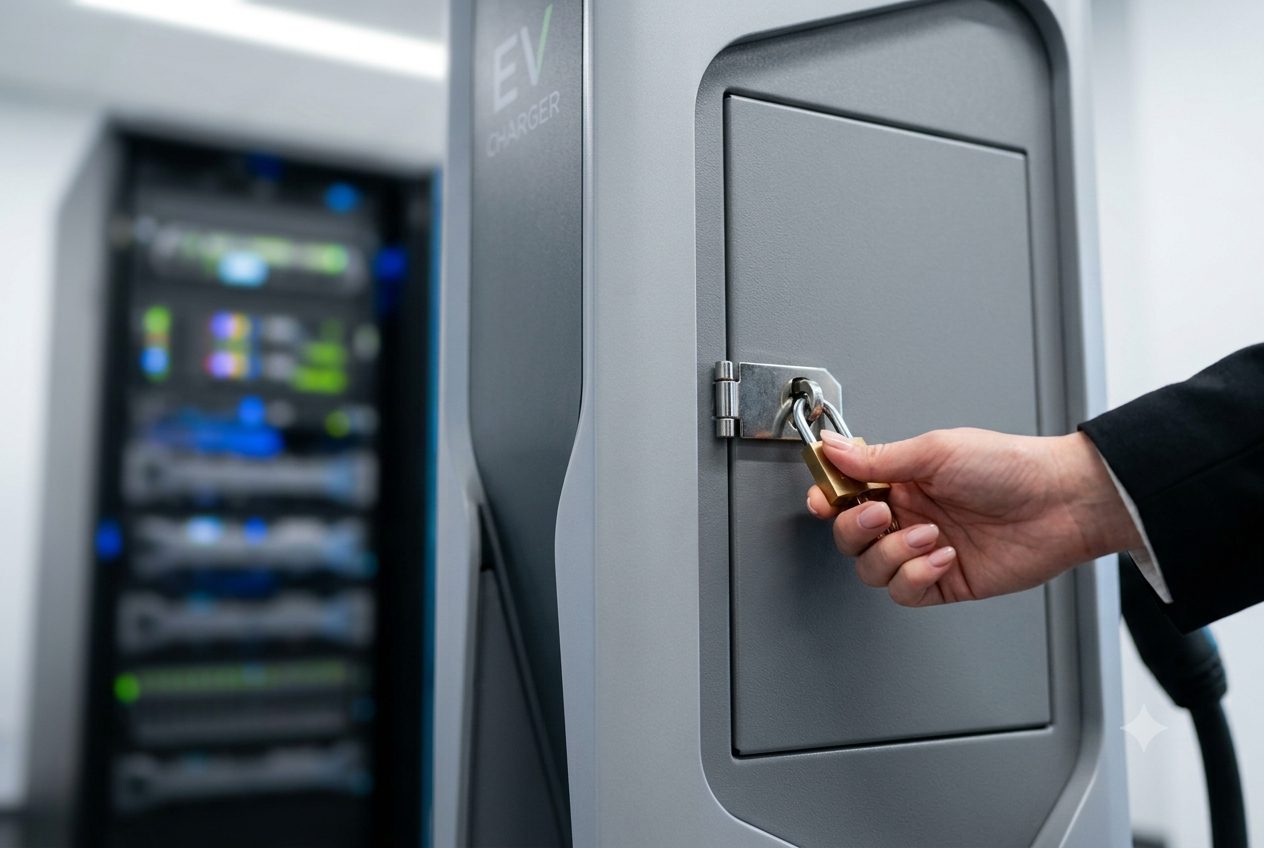
The Actionable Insight: Physical locking mechanisms on your charger housings are just as important as digital firewalls. If a vandal can easily open the pedestal door with a generic key, your entire corporate network is physically exposed.
Calculating Your Exposure: The Threat Exposure Score
To prioritize cybersecurity capital spend, IT departments use a Threat Exposure Score (TES) to quantify the risk of an endpoint breach. This evaluation considers the number of network-connected chargers you have, the probability of a localized network breach, and the financial impact a corporate network compromise would have on your business.
Imagine a corporate headquarters installing a bank of 24 smart chargers. If those chargers are deployed on a public-facing corporate Wi-Fi network without any segmentation, the probability of a breach over a standard three-year window is dangerously high, and the financial impact of a corporate database breach would be devastating.
However, by taking basic network security precautions—such as implementing strict cellular VPN tunnels and isolating the payment gateway—that same property developer can reduce their cyber risk exposure by over 93%.
OCPP Security Profiles & Network Segmentation
When purchasing EV charging hardware and software, you must ensure they meet modern security protocols.
OCPP Security Standards: Make sure your software operates on the OCPP 1.6 Security Whitepaper standards or native OCPP 2.0.1.
Security Profile 1: This involves no encryption (unsecured HTTP communications). You should avoid this entirely in 2026.
Security Profile 2: This offers basic TLS encryption paired with basic usernames and passwords.
Security Profile 3: This utilizes client-side certificate-based TLS authentication and is considered the gold standard for preventing "man-in-the-middle" data snooping.
The Ultimate Shield: VLAN Segmentation The golden rule of EV charger deployment is this: never connect a charger to the same network switch or Wi-Fi network used by your office computers, accounting departments, or resident portals.
Instead, create a dedicated Virtual Local Area Network (VLAN) that only allows the chargers to talk outward to their specific cloud management server. This blocks all lateral traffic between the chargers and the rest of the building.
Going Cellular Whenever possible, bypass the building's physical network entirely. The safest deployment method is to use industrial 4G/5G LTE cellular modems with private APNs (Access Point Names) embedded directly in the chargers.
Take Action on Your Network Security
EV chargers are highly visible, physical endpoints. Securing them requires a combination of physical locks, strict network segmentation, and modern OCPP encryption protocols.
Ask your IT director or facilities team this week: "What network are our EV chargers plugged into?" If they tell you they are on the main building LAN, treat that as an immediate security emergency. Segment that network before the weekend.
Join us next week as we shift our focus to the residential market and explore how resident demographics are shifting the used EV market.