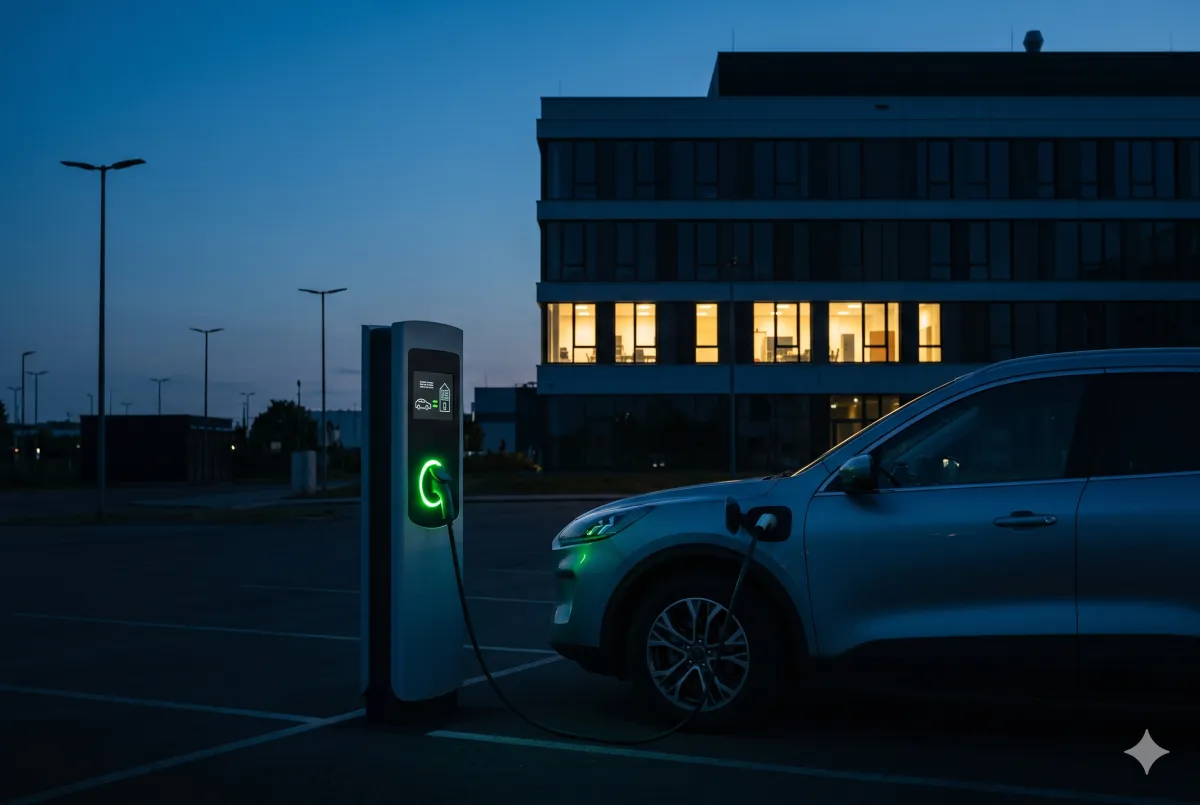
When the Grid Goes Dark: Using EVs for Commercial Backup Power
What Commercial Property Owners Need to Know
Vehicle-to-Building (V2B) technology allows commercial properties to use the stored energy in parked electric vehicles as an emergency backup power source during grid outages. By installing bidirectional, ISO 15118-compatible chargers and a transfer switch, property owners can offset the costs of expensive diesel generators while keeping essential building systems online. Evaluating V2B feasibility is quickly becoming a crucial step for new developments and commercial hardware upgrades.
For commercial real estate owners, developers, and facility managers, the threat of a grid outage means evaluating expensive backup energy solutions. But what if your parking lot could serve as your backup generator?
Through Vehicle-to-Building (V2B) technology, the electric vehicles sitting outside your condo complex, office building, or fleet depot can be transformed into a mobile energy storage system. When the grid goes dark, your building doesn't have to. Here is how commercial properties can leverage EV charging for emergency backup power.
What is Vehicle-to-Building (V2B) EV Charging?
You may have heard of Vehicle-to-Grid (V2G), where vehicles sell energy back to the local power company. Vehicle-to-Building (V2B) operates on a similar principle, but instead of sending power back to the grid, the EVs supply power directly to your facility.
When a storm hits or the power goes out, the EVs plugged into your commercial charging stations push stored energy from their batteries back into your building to run critical systems.
Can a parking lot of EVs really power a commercial building?
It is a common misconception that you would need hundreds of cars to power a building. The key is understanding that V2B is not designed to power 100% of a massive commercial load. Just like a traditional emergency backup generator, V2B is designed to power the emergency panel.
During an outage, you only need to run essential systems:
Emergency hallway and stairwell lighting.
Elevators (to ensure occupants can safely exit).
Basic HVAC and refrigeration systems.
Security systems and electronic doors.
By targeting only the critical load, V2B becomes a highly viable, cost-saving alternative (or supplement) to traditional battery energy storage systems (BESS) or diesel generators.
How many EVs does it take to run an emergency power load?
Let's look at the math for a hypothetical 100-unit condominium complex.
Assume the building's emergency panel requires 100 kilowatts (kW) of power to keep lights, security, and elevators running safely. If you want the building to survive a four-hour outage, you need 400 kilowatt-hours (kWh) of total energy.
A typical modern EV has roughly an 80kWh battery. Assuming a 90% transfer efficiency rate, one fully charged EV can provide about 72kWh to the building.
Best Case Scenario: It would only take 5.5 fully charged EVs to power the entire 100-unit condo's emergency systems for four hours.
Realistic Scenario: We cannot assume every plugged-in car is at 100% state-of-charge. Factoring in a 50% availability rate, you would only need about 11 to 12 EVs plugged into your lot to run the building safely. In a 100-unit building, having 12 EV drivers is a highly probable scenario.
Traditional Generators vs. V2B EV Charging
Feature:
Traditional Diesel Generator
V2B EV Charging System
Capital Investment:
High (Requires dedicated equipment purchases of $10k+)
Low to Medium (Leverages hardware you are already installing)
Fuel Costs:
High (Burns expensive diesel fuel hourly)
Zero (Uses energy already stored in tenant/customer vehicles)
Space Requirements:
High (Requires dedicated concrete pads and fuel storage)
Zero (Utilizes existing parking spaces)
Maintenance:
High (Requires regular mechanical servicing and testing)
Low (Handled via EV charging managed services and software)
Environmental Impact:
Poor (Emissions, noise pollution, fossil fuels)
Excellent (Clean, silent, renewable energy transfer)
What are the hardware and software requirements for V2B?
You cannot simply plug a car in and expect it to power a building. A V2B setup requires precise, commercial-grade infrastructure to operate safely.
ISO 15118-20 Compatible Chargers: You must install bidirectional chargers that communicate via the ISO 15118 standard (often known as "Plug & Charge"). This standard allows the charger and the vehicle to communicate seamlessly regarding power flow.
Emergency Transfer Switch (Crucial): This is a non-negotiable safety requirement. A transfer switch physically disconnects your building from the main grid during an outage. Without it, the power coming from the EVs would "backfeed" into the neighborhood grid, creating a massive safety hazard for utility workers trying to fix the lines.
Energy Management System (EMS) Software: Your EV charging management software must dictate the rules. The software tells the charger when to pull power, and more importantly, it sets safety limits (e.g., "Never drain a tenant's car below 20% battery so they can still drive to work").
Who owns the power in a commercial V2B scenario?
If a tenant or hotel guest plugs into your charger, does the property owner have the right to drain their battery to power the building?
This is solved through your service agreements. Property owners can work with their EV charging managed service providers to implement opt-in clauses. For example, an apartment complex might offer tenants a reduced monthly charging rate or free charging hours in exchange for allowing the building to utilize 20% of their battery capacity during rare grid emergencies.
If you are a commercial property owner planning a new development or an electrical upgrade, now is the time to perform a commercial EV charging feasibility study. Stop spending money on massive diesel generators when the solution might already be parking in your lot.